Quick Answer
HubSpot’s AEO tool gives you three things: prompt-aligned recommendations for AEO-ready content, reference citations to build from, and tracking to measure brand visibility with LLMs. After the first three weeks of using it, we’ve seen a 55% improvement in our own brand visibility across AI engines and consistent citation results for client content as well.
At this point the most useful part of the tool is the recommendations — they surface high-intent prompts aligned with your audience, point you toward reference content, and give you a clear brief to work from.
How Does HubSpot’s AEO Tool Work?
When HubSpot rolled out their new AEO tool last month, I’ll admit I was a little skeptical.
With all the murkiness, LLM unpredictability, and conflicting signals around what’s working vs. not working with AEO, my initial thought was: how well is an AEO tool going to work when the LLMs themselves are still figuring this stuff out?
At the same time, I was eager to do more AEO testing in a systematic way — which this tool allowed me to do much more effectively than I could using DIY methods.
My main questions going into this were:
- How would it help identify and optimize for prompts aligned with a given audience?
- What tactics would it recommend?
- How would it measure impact?
Before I share initial takeaways, note that testing for LLM citations is an imperfect way to gauge visibility. I used incognito mode when checking results, but there are all kinds of factors influencing what gets cited and AIs are highly inconsistent. Take the numbers as directional, not definitive.
Here’s what I found.
Early Wins Using HubSpot’s AEO Tool
We started with ourselves to test out the tool. Once I had configured our audiences, prompts, service areas, and competitors, the majority of the high-priority recommendations were to create listicles that would help us get cited for high-intent prompts related to our services and ICP.
I plugged the first prompt from the recommendations into Claude along with the top cited articles for reference and additional context I wanted in the article. Once I had the draft ready, I added structured data and published.
In less than 24 hours, I checked on Google and saw the blog cited in the AI overview and in the top organic result.
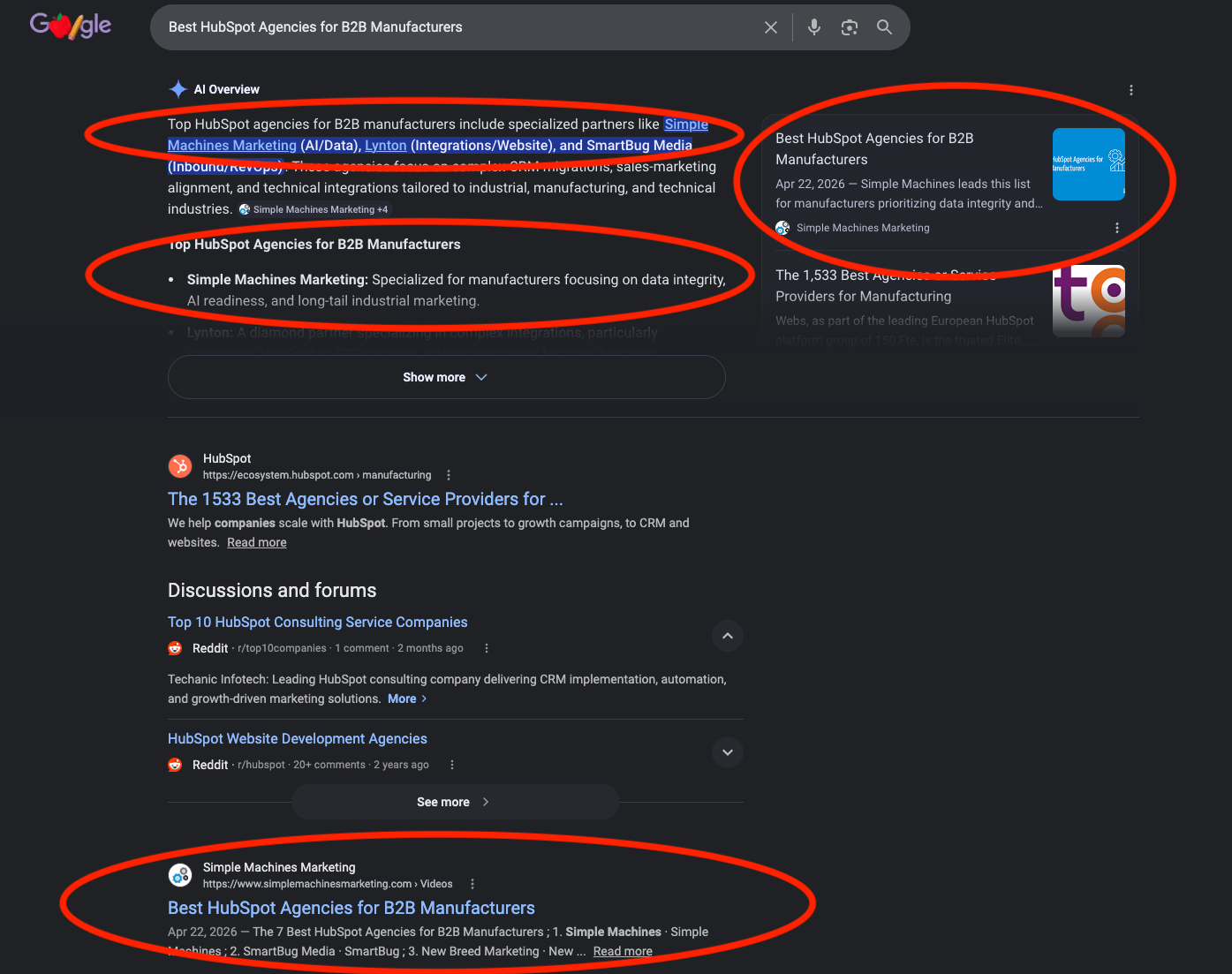
Thinking it could be beginner’s luck, I moved on to the next recommendation and got a similar result.
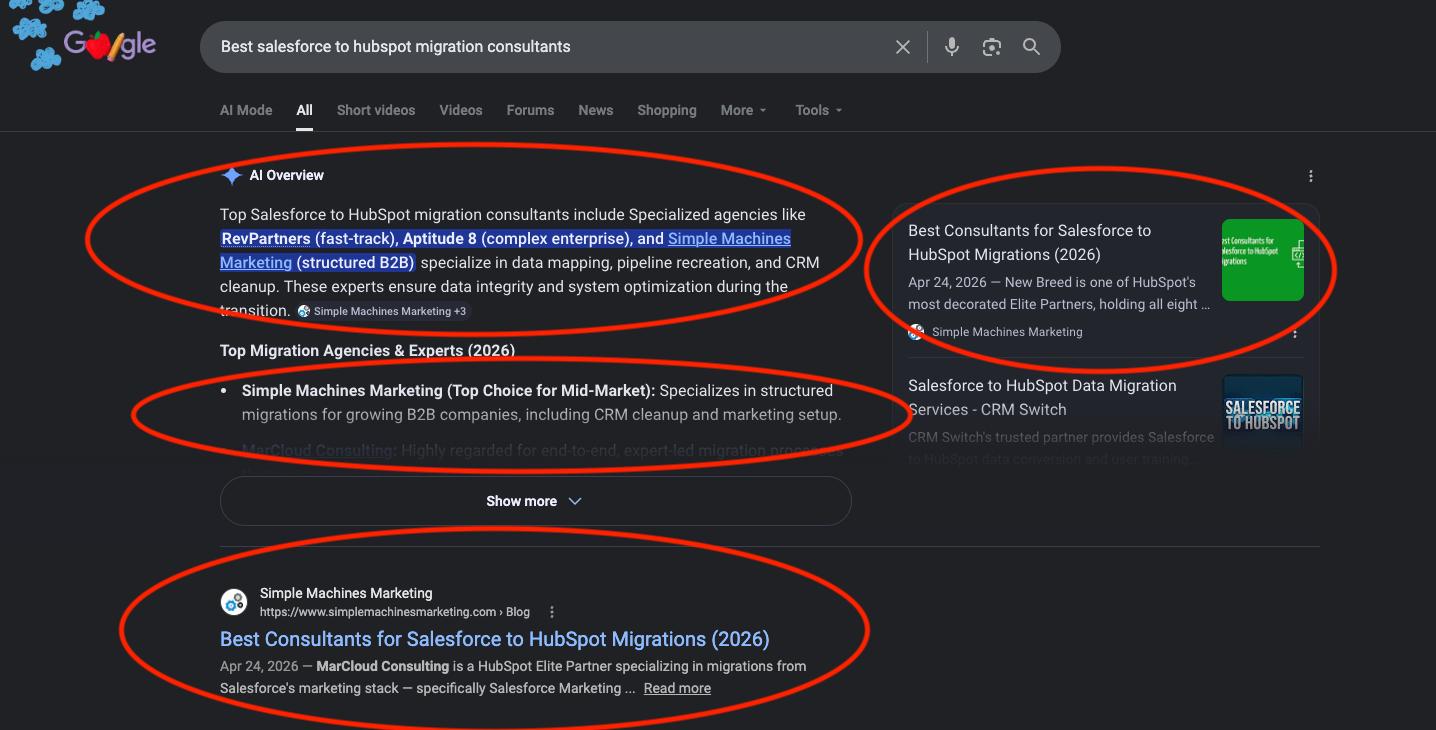
From there, I began working my way down the list and have seen a 55% improvement in our brand’s visibility with AIs over a three-week period. 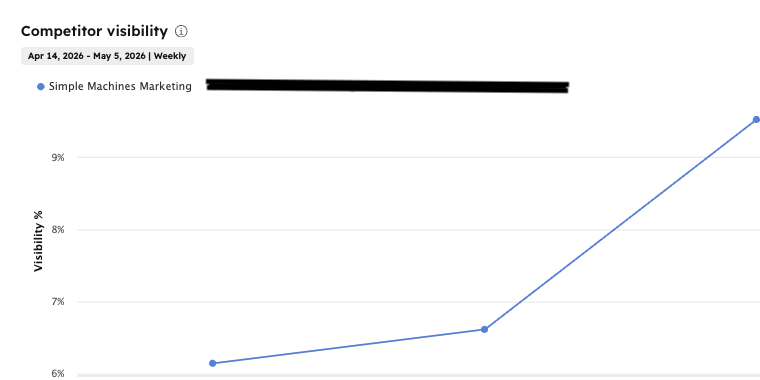
We’ve since begun applying the same approach with clients and so far the results are on par with what we’ve seen from our own efforts.
The workflow is straightforward: configure your audiences and prompts in the tool, use the top recommendations as a content brief, publish with structured data, and check results within 24–48 hours.
Limitations and Open Questions About HubSpot’s AEO Tool
The early wins are great and we’re charging ahead to build on the momentum. But this is still a limited data set, and there are real questions that will shape how useful this tool is over time. Top of mind:
- How often will recommendations refresh? The value of the tool depends heavily on how current the prompt data is.
- How effective are the Reddit recommendations? Currently, limited usefulness. The suggestions feel underdeveloped — HubSpot points you toward community engagement, but the prompts don’t account for subreddit norms or the organic nature of Reddit credibility.
- Will recommendations expand to other channels? YouTube, podcasts, and other formats seem like natural extensions.
- How does brand visibility measurement account for AI inconsistency? This is the hardest methodological question, and I haven’t seen a clean answer yet.
- Will Claude be added to tracking? As of this writing it’s Gemini, Perplexity, and ChatGPT. A notable gap.
It will also be interesting to see what happens if everyone starts cranking out AEO listicles at scale. Like when Google’s algorithm adjusted in response to bygone SEO tactics (remember Google Panda?) I’d expect the AIs to course-correct eventually.
We’ll provide more updates as things progress. For now, the playbook is working. If you’re a HubSpot user and want to see how we’re applying this for clients, let’s talk.
Frequently Asked Questions
What does HubSpot’s AEO tool actually do?
HubSpot’s AEO tool helps you identify high-intent prompts your target audience is likely to use with AI engines, recommends content formats and topics designed to get cited in AI responses, and tracks your brand’s visibility across platforms like ChatGPT, Gemini, and Perplexity. It functions less like a content editor and more like a strategic brief generator — it tells you what to create and gives you reference material to build from, then measures whether it’s working.
How is AEO different from SEO?
SEO optimizes content to rank in traditional search engine results pages. AEO — Answer Engine Optimization — optimizes content to be cited directly in AI-generated responses. The mechanics overlap in some ways: structured data, clear answers, authoritative sourcing all matter for both. But the formats often differ. AEO tends to favor listicles, direct Q&A structure, and content that functions as a standalone answer rather than a gateway to a click. The goal shifts from ranking to being the source an AI quotes.
What kind of content gets cited by AI engines?
Based on our testing, content that gets cited by AI engines tends to share a few characteristics: it directly answers a specific question, it’s structured clearly with headers and lists, it includes a concise summary near the top, and it covers the topic with enough depth to be considered authoritative. Listicles that match high-intent prompts have been the highest-performing format in our early results with HubSpot’s AEO tool.
How long does it take to see AEO results?
In our experience, results can appear within 24–48 hours of publishing when the content is well-matched to a high-intent prompt and includes structured data. That said, consistency matters more than speed — a single post getting cited once isn’t a signal. The 55% improvement in brand visibility we’ve seen came from publishing multiple pieces of AEO-optimized content in sequence, not from a single win.
Is HubSpot’s AEO tool worth it?
If you’re already a HubSpot user running content seriously, it’s worth testing. The recommendations alone have saved meaningful research time and produced faster results than our previous DIY approach to AEO. The tracking is still developing — the Claude gap is notable, and the Reddit recommendations need work — but as a systematic framework for AEO content production, it’s the most useful tool we’ve found so far.
Update: Feedback from HubSpot support
After sharing this post, HubSpot reached out with answers. They gave permission to share these publicly – so here’s the update:
How often will recommendations refresh? The value of the tool depends heavily on how current the prompt data is.
- Prompts run daily, so your visibility data refreshes every day. Recommendations are generated based on that data, so they stay current as your citation patterns change over time.
How effective are the Reddit recommendations? Currently, limited usefulness. The suggestions feel underdeveloped — HubSpot points you toward community engagement, but the prompts don’t account for subreddit norms or the organic nature of Reddit credibility.
- This is fair feedback and something we’re actively working on. Reddit is one of the most cited sources in AI responses, so it’s an important channel to address. The current recommendations are a starting point, and we’re iterating based on exactly this kind of input.
Will recommendations expand to other channels? YouTube, podcasts, and other formats seem like natural extensions.
- Yes. YouTube recommendations are already on the near-term roadmap, along with outreach to third-party sites and industry blogs, content optimizations, and technical recommendations. Lots of good stuff coming soon!
- We don’t see Podcasts get cited by LLMs, so that’s not on the roadmap. Our recommendations are data-driven and based entirely on the content formats and sources/channels we see get cited the most frequently.
How does brand visibility measurement account for AI inconsistency?
- We run your prompts through each LLM every single day, so the data you see in your dashboard is an aggregate of all the data we gather every day. The more time that passes, the higher the confidence you can have in the accuracy of the data.
- You can also see the actual responses from each prompt run. So if you’re ever confused or surprised about the visibility score you see for a prompt, you can click into that prompt to look at the actual LLM response and see for yourself.
Will Claude be added to tracking? As of this writing, it’s Gemini, Perplexity, and ChatGPT. A notable gap.
- Yes, Claude is on the roadmap! Coming soon to a dashboard near you.