HubSpot playbooks have been around for years, but if you’ve not reviewed them recently, perhaps you should. They’ve come a long way since they were first introduced.
Playbooks are tools that help marketing and sales teams work in effective, standardized ways. Consistency is critical for multiple reasons (more on that below), but at the end of the day, it helps companies grow and thrive.
So, let’s look at HubSpot playbooks: what they are, their benefits for marketing and sales teams, and how to create them.
What Are HubSpot Playbooks?
HubSpot playbooks are essentially collections of tactics and resources used to enhance and streamline marketing and sales processes. For example, you might create a playbook to guide your sales team on how to have a specific conversation with prospects.
Let’s say you’ve figured out through many calls how to overcome a particular objection. In that case, you can create a playbook that helps reps master that conversation and avoid a prolonged (and potentially costly) trial-and-error learning process.
General Benefits of HubSpot Playbooks
At a high level, HubSpot playbooks help companies achieve their business goals in multiple ways. First and foremost, they standardize processes – and lots of good stuff flows from consistency!
For one thing, it helps individuals and teams be more productive since there’s no time or energy wasted on “recreating the wheel.” And if the need arises to tweak the wheel, the fact that everyone performs a process the same way makes it easy to identify where it can be improved.
Consistency also creates better customer experiences since everyone on the team follows approved best practices. Plus, if a prospect talks with multiple people, it’s reassuring to them that everybody’s using the same messaging and approach.
How Marketing Teams Leverage Playbooks
Marketing departments that create playbooks benefit from them in many ways, including:
- Streamlined sales and marketing alignment
- Enhanced customer engagement through personalized interactions
- Increased efficiency in marketing campaigns
- Better insights for refining strategies and tactics
Those are the operational benefits, but there are also psychological benefits, like feeling more supported and confident in your work – and who wouldn’t welcome a little stress reduction in their day?
How Sales Teams Leverage Playbooks
Like marketing teams, sales teams gain several advantages from using playbooks, like:
- More effective customer interactions. Playbooks enable sales reps to have productive conversations with stakeholders. That includes making personalized pitches, conducting seamless follow-ups, answering questions quickly, and overcoming objections.
- Greater consistency. We emphasized the value of standardization above, but nowhere is it more critical than for sales teams. Ensuring everyone has access to the same high-quality information and strategies and uses those resources the same way can be a game-changer.
- Improved efficiency. Playbooks promote efficiency in various ways. Onboarding sales reps efficiently means they’re closing deals and generating revenue faster. Playbooks also help reps quickly find the resources they need, which can streamline and accelerate the sales cycle.
- Increased close rate. Playbooks help reps keep deals moving forward. With no delays or distractions, they can achieve a higher close rate.
- Data-driven insights. Following playbooks helps sales teams analyze what strategies are working and make improvements based on stats rather than hunches.
How To Create HubSpot Playbooks
Like everything in HubSpot, creating playbooks is quick and easy. The process has five basic steps:
- Identify your goal. The most effective playbooks have well-defined objectives – so, not “sell product A” but more like “overcome price objection to product A.”
- Gather the necessary information. You should have or know the location of every resource your playbook will reference, including data, resources, guidelines, etc.
- Draft the playbook. This is when you define the process chronologically, including the steps, scripts, and best practices. (See below.)
- Customize and personalize it. You can – and really should – tailor playbooks to address different scenarios and audiences.
- Integrate it with HubSpot. Finally, you integrate the playbook into HubSpot, assign it to teams, and ensure it’s accessible.
Creating a playbook is relatively straightforward. First, navigate to Library > Playbooks and click “Create playbook” at the upper right. You can produce playbooks from scratch or use the provided templates.
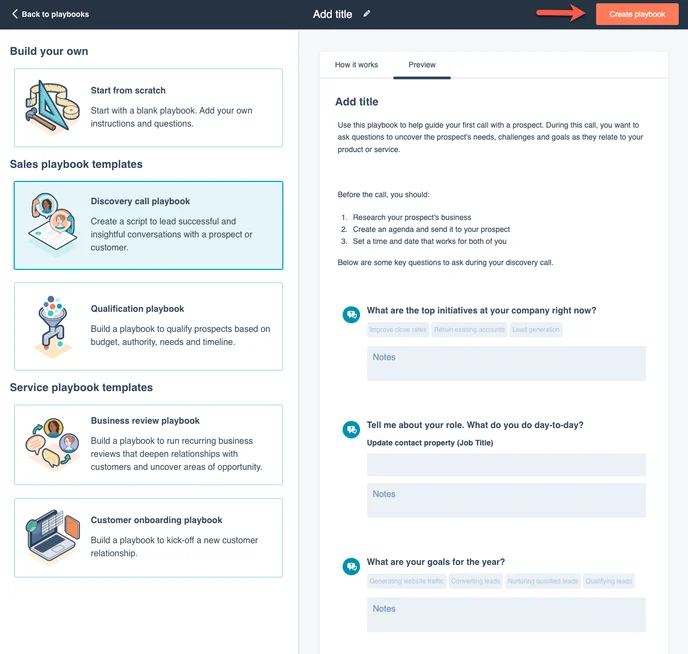
After giving your playbook a name and clicking “Create playbook,” you develop the content. You can get help from HubSpot’s AI content writer if appropriate.
Playbooks can have text, questions, images, links, and more. Enterprise HubSpot users can even update properties in HubSpot records based on what’s entered into a playbook!
Once you save your playbook, it’s ready to use. You can log playbook activity in records much like you can with other activities.
Best Practices for Using HubSpot Playbooks
If you decide to enhance your marketing or sales processes with playbooks, here are some tips for getting the most from them:
Keep them simple. Avoid overcomplicating playbooks with too much detail.
- Update them regularly. Continuously update your playbooks to reflect the latest best practices and market trends. They are not “set it and forget it” tools!
- Incorporate feedback. Use team and customer input to improve your playbooks.
- Train your teams. Ensure all team members are comfortable using playbooks to encourage adoption.
- Measure effectiveness. Track metrics to evaluate the impact of your playbooks, and then make data-driven adjustments.
- Summing It Up: Pros and Cons of HubSpot Playbooks
There are many advantages to using HubSpot playbooks. Of course, like all marketing and sales tools, they have some disadvantages.
Pros:
- Consistency. Playbooks ensure uniformity in communications and processes.
- Streamlined onboarding and training. Getting team members up to speed and productive is easier with playbooks.
- Increased efficiency. Playbooks save time and effort by providing ready-to-use templates and guides.
- Data-driven decisions. Playbooks facilitate the collection and analysis of interaction data.
- Scalability. It’s simple to replicate successful processes across an organization with playbooks.
Cons:
- Initial setup time. Creating comprehensive playbooks requires an initial investment of time and effort.
- Potential process rigidity. Following playbooks too closely can inhibit flexibility and agility.
- Maintenance requirements. Playbooks need to be updated regularly to ensure they stay relevant and effective.
Final Thoughts
Ask any company using HubSpot playbooks what they think of these tools, and they’ll likely tell you they love them. Playbooks drive consistency, streamline onboarding and training, increase productivity, improve prospect/customer satisfaction, and enable process analysis and improvement. What’s not to love?
If your company isn’t using playbooks but wants to, it’s easy to define and integrate them into your sales processes. Or you can capitalize on our playbook expertise to implement them even faster and more effectively.
Contact us whenever it’s convenient to talk about your goals and how we can help you reach them.