


Client Profile
Threekit is an AI sales agent built for manufacturers with complex products. Trusted by more than 150 manufacturers, Threekit’s platform drives leads by guiding buyers, reps, and dealers accurately across every channel. Their marketing site runs on HubSpot Content Hub — and when their positioning evolved, their website needed to catch up fast.
Case Study Highlights
Threekit needed a new marketing website that reflected their updated positioning and AI-forward product story. With their site on HubSpot Content Hub, the challenge was translating a finished design system into a live, editor-friendly theme — without a multi-week development sprint or sacrificing the platform capabilities their marketing team depended on.
Simple Machines used Claude Design and Claude Code in an iterative, compounding workflow: design artifacts flowed directly into theme development, and modules built early in the project were reused and extended across every subsequent template.
The result: 36 custom HubSpot modules and 7 page templates — including a full blog system and HubDB-powered case study listing — with the core theme live in HubSpot Design Manager in a single day.
Key deliverables included:

The Challenge
The Solution
Our strategy was to approach this as an AI-native delivery problem, not than a development resource problem.
Rather than staffing up with a developer and running a traditional sprint, we mapped the build to three tools — Claude Design, Claude Code, and HubSpot Content Hub — each owning a distinct phase with direct handoffs between them. The strategic insight was that an AI coding agent (Claude Code) connected directly to HubSpot’s API could close the gap that normally makes website builds expensive and slow.

Phase 1
Design system to working theme (one day)
Claude Design produced the complete visual language: brand tokens, typography scale, spacing, button variants, and a full showcase page that became the reference for all downstream development. Once the design was approved, those files were passed directly to Claude Code.
Claude Code read the design output, connected to HubSpot via CLI and a private app token, and built the theme from scratch — scaffolding modules, writing HubL, and pushing files into Design Manager in a continuous loop of read → build → upload → fix → verify. No handoff document, sprint planning or waiting.
By end of day one: a complete custom HubSpot theme was live in Design Manager, with a showcase pre-populated with real content from the design’s source HTML, ready to preview immediately.
Phase 2
Compounding reuse across templates
Rather than starting from scratch for each subsequent template, Claude Code reused and extended the module library built in phase one. Each new template — blog listing, blog post, case study listing (with HubDB integration), awards page — pulled from the existing component library and added to it.
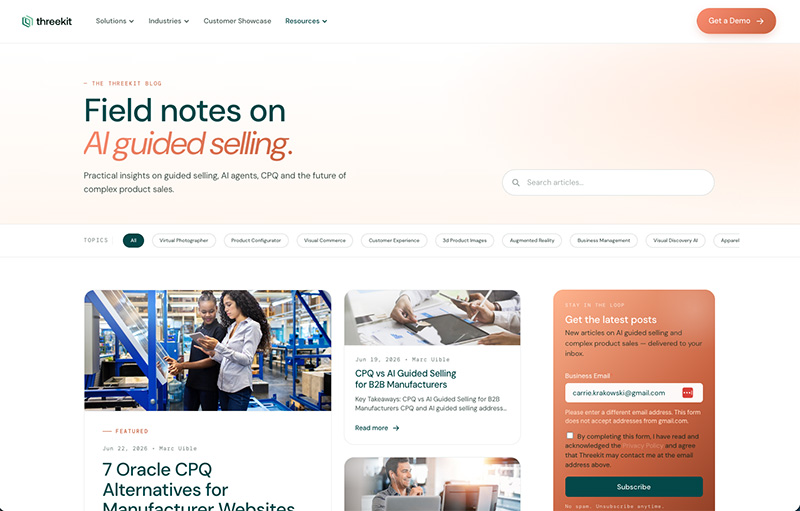
The blog listing template was designed in Claude Design using the existing brand assets as reference, then built in Claude Code. Same process for the blog post template (sticky share rail, drop cap, author card, related posts, configurable sidebar — all field-controlled from the HubSpot editor). The case study listing pulled from a HubDB table. Each session reinforced the system with no need to rebuild it.


The Results
36 Custom HubSpot Modules + 7 Templates Built
Including full blog + HubDB-based case study system. All editor-friendly, field-controlled.
Core Theme Live in One Day
Marketing Team Independence
Threekit’s team can update text, images, button styles, layout options, and form selections directly in HubSpot without developer involvement. Every module ships with editor-friendly field controls — no developer required for day-to-day content management.
Complete Design System Integration
Brand tokens, typography scale, and button variants preserved end-to-end

“Simple Machines took our design system and had a fully custom HubSpot theme live — modules, templates, sections — in a single session. Now we can manage it without a developer. That’s exactly what we needed.”
Let’s Chat
Want to be our next success story? Fill out the form to get started.


