


Most build and construction companies can’t trust their HubSpot data.
The issue isn’t missing features or bad configuration – and it goes beyond basic data hygiene and completeness.



The real problem
The real problems are inconsistent inputs, undefined ownership, misaligned definitions and unenforced processes.
The result:
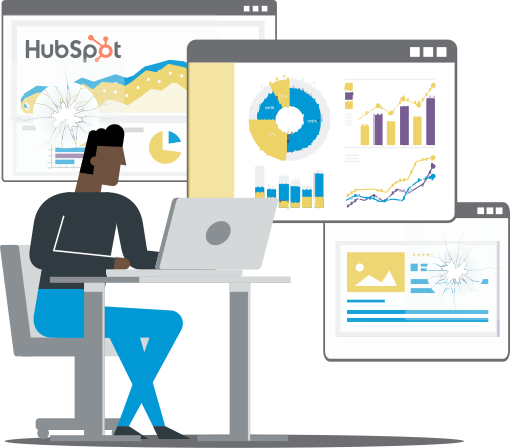
Dashboards no one trusts
Unpredictable AI and automation
Inconsistent lead stages and scoring
Attribution that doesn’t hold up
These are the symptoms of broken Data Trust.
What Data Trust actually means
Data Trust helps businesses trust their data for defensible reports and accurate AI.

Accurate points of entry

Processes that are tracked and enforced

AI and automation that behave predictably

Reporting that reflects reality
1. Decision-to-Data Mapping
We start with the decisions your team relies on and trace them back to the data that drives them.
This allows us to:
✓ Identify where trust actually breaks
✓ Ignore fields that don’t matter
✓ Focus the work where it counts
The goal: Establish a RevOps data foundation that supports attribution accuracy
2. Critical Data Definition
From those decisions, we derive a focused set of critical data points that must be accurate and consistent. For each one, we define:
✓ What it means
✓ When it must be set
✓ Who owns it
This provides the inputs for your data governance framework.
3. Data Creation & Process Mapping
We map where critical data is created and modified across key moments — lifecycle changes, stage transitions, handoffs and integrations. This surfaces:
✓ Inconsistent processes
✓ Unwanted overwrites
✓ Gaps between intent and reality
By mapping these, we develop a current state of data quality management.
4. Enforcement Inside HubSpot
We translate expectations into enforcement so data quality doesn’t rely on memory or training. This includes:
✓ Required fields at the right moments
✓ Guardrails that prevent bad data from progressing
✓ Automation to normalize values
These components comprise your most critical data integrity controls for Data Trust.
5. Ownership & Standards
We establish clear ownership so data trust holds over time. That includes:
✓ Responsibility for maintaining standards
✓ Guardrails for future changes
✓ Sales and marketing data alignment
✓ Simple ways to detect drift early
How We’re Different: Independent Data Verification
Most CRM consulting focuses on configuring fields, workflows, and reports inside HubSpot. That’s necessary but it doesn’t prove accuracy.
We use a lightweight external validation layer to independently verify the data flowing into HubSpot from other systems.
This allows us to run deeper checks that CRM tools alone aren’t designed for, such as:
- Cross-system reconciliation (CRM vs ERP, scheduling tools, or other systems)
- Completeness checks to confirm records weren’t dropped by integrations
- Historical audits to detect drift or process failures
- Independent verification of reports and calculations
This acts as a neutral verification layer — similar to how financial audits validate accounting systems. The result: traceable proof the numbers in your CRM can be trusted.
What this enables
Reliable reporting and analysis in HubSpot
Revenue attribution accuracy

Scalable automation that doesn’t break
AI-ready data

“Anyone familiar with CRM will know the monumental task that is data hygiene, and the Simple Machines team approached it with unparalleled finesse and precision. The result? A squeaky-clean HubSpot that flows like a dream, optimized for maximum efficiency.”