As a HubSpot agency that specializes in manufacturing, we've become keenly aware over the years of the unique challenges business owners in this industry face when trying to create predictable revenue growth.
When we started out, the big challenge was helping manufacturers adopt digital marketing tactics to generate demand. More recently, channels such as SEO, paid search and content that used to provide a steady stream of inbound leads have slowed to a trickle. On top of that, unpredictability in the market is sending ripple effects across manufacturers and supply chains worldwide.
Taken together, it's become more critical than ever for manufacturers to be able to leverage data to optimize marketing and sales channels.
In our experience, manufacturers often struggle to do this primarily because of the following reasons:
- They don't trust the data in their CRM
- They struggle to get the sales team to embrace technology
- They lack attribution to validate marketing and sales investments
If any of these sound familiar, you're not alone. In this article, we'll dig into the three most powerful ways manufacturers can use HubSpot to address these challenges and drive predictable revenue growth in today's competitive landscape.
(Related resource: HubSpot Value Audit for Manufacturers)
Leveraging Reliable Data for Smarter Decision-Making
Manufacturing executives are often forced to make critical business decisions based on incomplete information. Traditional manufacturing sales processes generate valuable data that frequently remains trapped in spreadsheets, email inboxes, or worse, the minds of individual sales representatives.
HubSpot solves this problem by centralizing your customer and prospect data into a single source of truth. When properly implemented, manufacturers can track and analyze:
- Lead source performance: Understand which channels (digital advertising, trade shows, referrals) generate the highest quality prospects
- Customer acquisition costs (CAC) by channel: Calculate the true cost of acquiring customers through different marketing methods
- Sales cycle length by product line: Identify which products move quickly through your pipeline and which require more nurturing
- Customer lifetime value analysis: Determine which types of customers provide the greatest long-term revenue opportunity
One of our clients in the manufacturing space was able to achieve real-time 360-degree view of business performance in HubSpot with comprehensive dashboards and custom reports tailored for executives, sales management and sales reps. This enabled the team to operate with true data-driven precision. To get a better idea of the Total Cost of Ownership for Hubspot, you can use our calculator for a full breakdown.
Implementing Attribution to Optimize Marketing Spend
Many manufacturing marketers struggle to justify their budgets because they can't clearly demonstrate how marketing activities impact the bottom line. This is particularly challenging in industrial sales with lengthy, complex buying processes involving multiple stakeholders and distributor channel partners.
HubSpot's attribution reporting capabilities solve this problem by tracking the entire customer journey from first touch to closed deal. This allows manufacturers to:
- Link specific marketing activities to revenue outcomes
- Understand which content pieces influence buying decisions
- Identify the most effective combinations of marketing channels
- Connect offline sales activities with digital marketing efforts
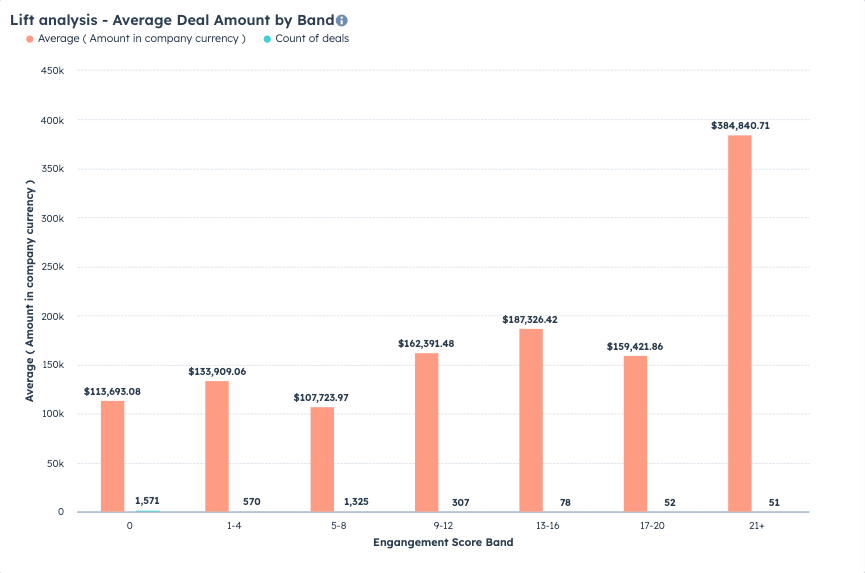
One client who was executing an ABM campaign was unsure how all the campaign activities were translating into actual results. By creating lift analysis reports in HubSpot, we were able to go beyond vanity metrics and report on outcomes that matter most — like revenue growth, lead quality and conversion rates.
Scaling Operations with Built-in AI Tools and Automation

Labor efficiency has always been central to manufacturing excellence. The same principle should apply to your sales and marketing operations.
Along with powerful automation tools, HubSpot's built-in AI capabilities allow manufacturers to streamline a wide variety of tasks that let your team save time and effort.
Key capabilities include:
- AI-powered virtual assistant: Fast-track content development, prospecting, research and more with Copilot
- Automated lead scoring and prioritization: Focus your sales team's time on prospects most likely to convert based on fit and engagement
- Breeze agents for fast social media and content creation: Spend less time creating content and more time fostering relationships that grow your business
- Predictive analytics for sales forecasting: Improve inventory planning with more accurate sales projections
- Chatbots for qualification and common questions: Provide 24/7 response to distributor and customer inquiries
An electrical harness manufacturer we worked with used HubSpot to automate over 30 sales actions. By removing these time-consuming tasks, the team was freed up to focus on prospecting and building customer relationships.
Common Obstacles Manufacturers Face with CRM Implementation
While the benefits of HubSpot for manufacturers are clear, many companies struggle to realize its full potential due to several common obstacles:
Unreliable Data
Manufacturing businesses often operate with siloed information across departments. Production may use an ERP system, while engineering uses project management software and sales relies on spreadsheets or legacy CRM tools. This fragmentation leads to:
- Inconsistent customer records
- Duplicate data entry causing errors
- Lack of visibility across the customer lifecycle
- Inability to generate trustworthy reports
Poor Sales Team Adoption
Manufacturing sales representatives typically spend years building customer relationships and often view CRM systems as administrative burdens rather than helpful tools. Common adoption challenges include:
- Resistance to changing established workflows
- Perception that time spent on data entry reduces selling time
- Inadequate training on how CRM actually benefits individual salespeople
- Lack of management enforcement of CRM processes
Limited Revenue Attribution Visibility
Even with a CRM in place, many manufacturers struggle to connect marketing activities to sales results because:
- Long sales cycles (often 6-18 months) obscure cause and effect
- Multiple decision-makers interact with different marketing touch points
- Traditional manufacturing sales processes involve significant offline interaction
- Complex distribution models add layers between marketing activities and end customers
Our Approach: Turning HubSpot into a Revenue Engine
At Simple Machines, we offer an easy-to-use system for optimizing the HubSpot platform and enabling team adoption. This system has been developed based on years of helping manufacturers overcome these challenges and transform HubSpot from a mere contact database into a trusted engine for measurable growth.
At a high level, our approach tackles these challenges head-on by:
- Ensuring accurate data through a focus on data integrations with ERPs and other tools and ongoing maintenance
- Effective training and enablement, leveraging our multiple in-house HubSpot Certified Trainers with years of training expertise
- Implementation of embedded enablement software to empower sales teams and ensure long-term adoption after training
- Attribution reporting to provide visibility on the best-performing marketing channels
Curious how it works? Get in touch with our team to learn how we can help you implement this system in your manufacturing business.