For anyone at all acquainted with HubSpot, you're likely familiar with two terms: HubSpot onboarding and HubSpot implementation.
If you're about to purchase HubSpot and you're planning to work with a HubSpot Solutions Partner, you'll see HubSpot services related to both. Adding to the confusion is the fact that these terms are sometimes used interchangeably to speak broadly to the concept of getting a business running on HubSpot.
As a business that lives in this particular niche, we're going to be sticklers here and point out that there are key differences and that it's to your benefit to understand the distinction.
If you've wondered what the difference is between HubSpot onboarding vs. HubSpot implementation, you're in the right place. This post will break down the differences between the two and help you determine which option is best suited to your business based on your needs, resources and familiarity with HubSpot.
What is HubSpot Onboarding?
Think of HubSpot onboarding as a "do-it-with-me" service where you work alongside an onboarding specialist or consultant to complete essential tasks that drive product activation and usage. The focus is on getting your team comfortable with HubSpot's core features and ensuring you have the knowledge to manage your setup as you go.
Typically, onboarding takes about 90 days to complete and is oriented around a handful of agreed-upon objectives.
What to Expect from Onboarding
Onboarding tends to cover tasks like setting up basic features, importing contacts, creating email templates and establishing a few foundational workflows. Your onboarding specialist will guide you through these steps, but you'll be an active participant, working hands-on to complete each task.
This approach is ideal for teams that want to learn by doing and gain a deep understanding of the platform early on. You'll have the support of an expert to guide you through initial hurdles, but much of the setup will be a collaborative process.
(It is also worth noting that onboarding with a solutions partner will be more customized and hands-on than onboarding with HubSpot.)
Onboarding is best for:
- Teams with internal resources and capacity to handle setup tasks alongside a consultant.
- Businesses looking to build confidence in HubSpot through hands-on experience.
- Those who only need basic setup and core functionality to start.
What is HubSpot Implementation?
Where onboarding is "do-it-with-me", HubSpot Implementation is a "do-it-for-me" service that involves an implementation partner taking the lead on setup, customization and training based on your business's goals and requirements. Unlike onboarding, where you're closely involved in each step, implementation is largely managed by the partner, allowing you to focus on your business while they handle the technical work.
Another way to think about this is that with implementation, you're sharing your vision with the implementer, and they're providing the roadmap and execution to turn that vision into reality.
What to Expect from Implementation
Implementation typically includes more advanced configurations and tailored setup, such as building complex workflows, custom reports and integrations with other systems. Your role in the implementation process is primarily consultative — sharing your goals, key objectives and any specific requirements with the partner, who then manages the project and delivers a customized HubSpot environment tailored to your needs.
This approach is ideal for companies that require a more advanced or customized setup or lack the internal resources to handle a complex implementation. It ensures your setup is optimized from the start, helping you hit the ground running with a fully functional portal configured to your specific needs.
Depending on the requirements and complexity of the desired setup, implementation can take anywhere from a month to nine months or more.
Implementation is best for:
- Companies with limited time or internal resources to manage the setup.
- Businesses that require complex workflows, advanced reporting, or integrations.
- Organizations looking for a tailored solution that meets specific, high-level goals.
What Are the Differences Between HubSpot Onboarding and HubSpot Implementation?
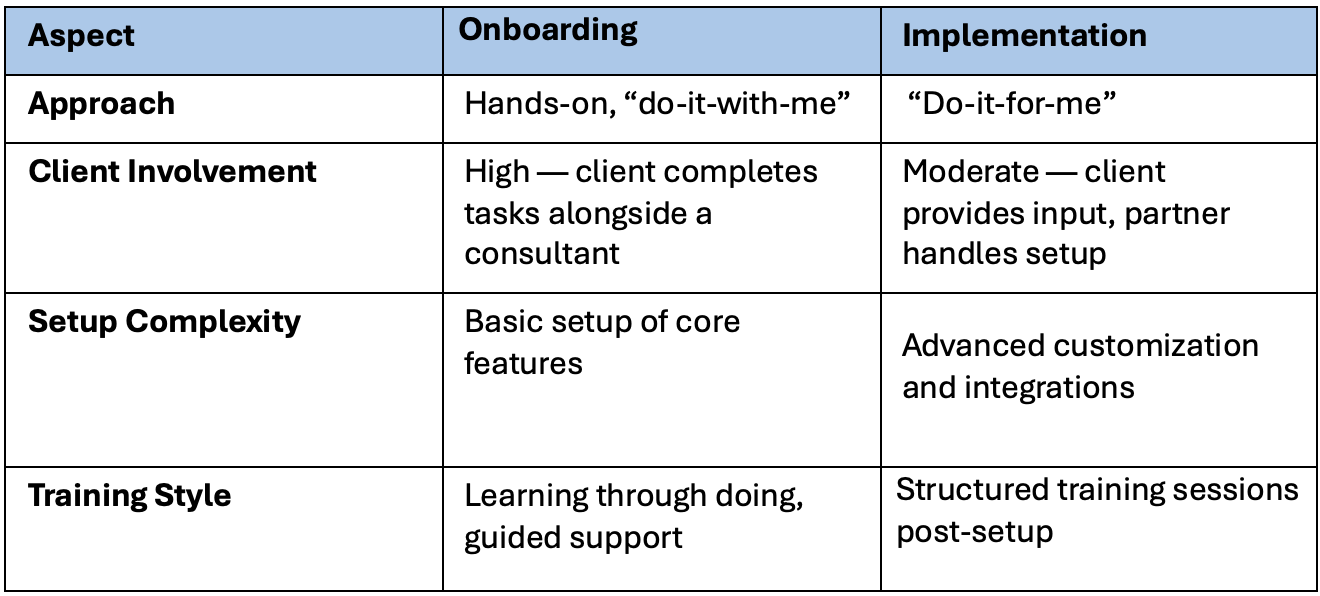
Hands-On vs. Hands-Off
- Onboarding requires you to be actively involved, learning HubSpot by performing tasks with the support of a consultant.
- Implementation allows you to delegate the technical work to an expert partner who sets everything up on your behalf.
Basic vs. Advanced Setup
- Onboarding covers essential tools and features, providing a foundation for using HubSpot effectively.
- Implementation includes more complex configurations, such as custom properties, detailed workflows, and integrations with other platforms.
Training Approach
- Onboarding emphasizes hands-on learning, with you performing tasks alongside the consultant, gaining practical experience with HubSpot.
- Implementation typically involves structured training sessions after the setup so your team can make the most of the custom configurations.
How to Decide Which Option Is Right for Your Business
Assess Your Internal Resources
If your team has the time and capacity to be hands-on and you want to have a HubSpot admin learn the platform through practice, onboarding can be a good way to gain that experience. However, if your team is already busy or lacks the expertise to take on the setup process, implementation may be a better choice, allowing you to focus on other priorities while your HubSpot setup is handled for you.
Consider Your Familiarity with HubSpot
If your team is new to HubSpot, onboarding can be a valuable learning experience. You'll gain confidence and understanding by working directly within the platform. If you have experience with HubSpot or need a more customized setup, implementation may be the right choice, as it provides advanced configuration and tailored support without requiring deep HubSpot knowledge upfront.
Evaluate the Complexity of Your Requirements
For businesses with basic setup needs, onboarding will likely cover everything required to get started effectively. But suppose your company requires advanced workflows, custom properties or integrations with other tools. In that case, implementation is a more comprehensive solution that will give you a setup optimized for your specific goals.
Final Thoughts
As we've covered many times on this blog, HubSpot is an incredibly powerful platform that helps businesses grow, but the tools are only effective when they're put to use effectively. Choosing the right approach to getting started with HubSpot — whether onboarding or implementation — can make a significant difference in how effectively you leverage the platform.
Both options support you in maximizing HubSpot's potential, but choosing the right one depends on your resources, familiarity with the platform and specific needs.
Hopefully, this cleared up the difference between HubSpot onboarding vs. HubSpot implementation. If you're ready to set up HubSpot but need expert guidance, learn more about HubSpot onboarding and implementation services with Simple Machines. Contact us to schedule a consultation and get started!