



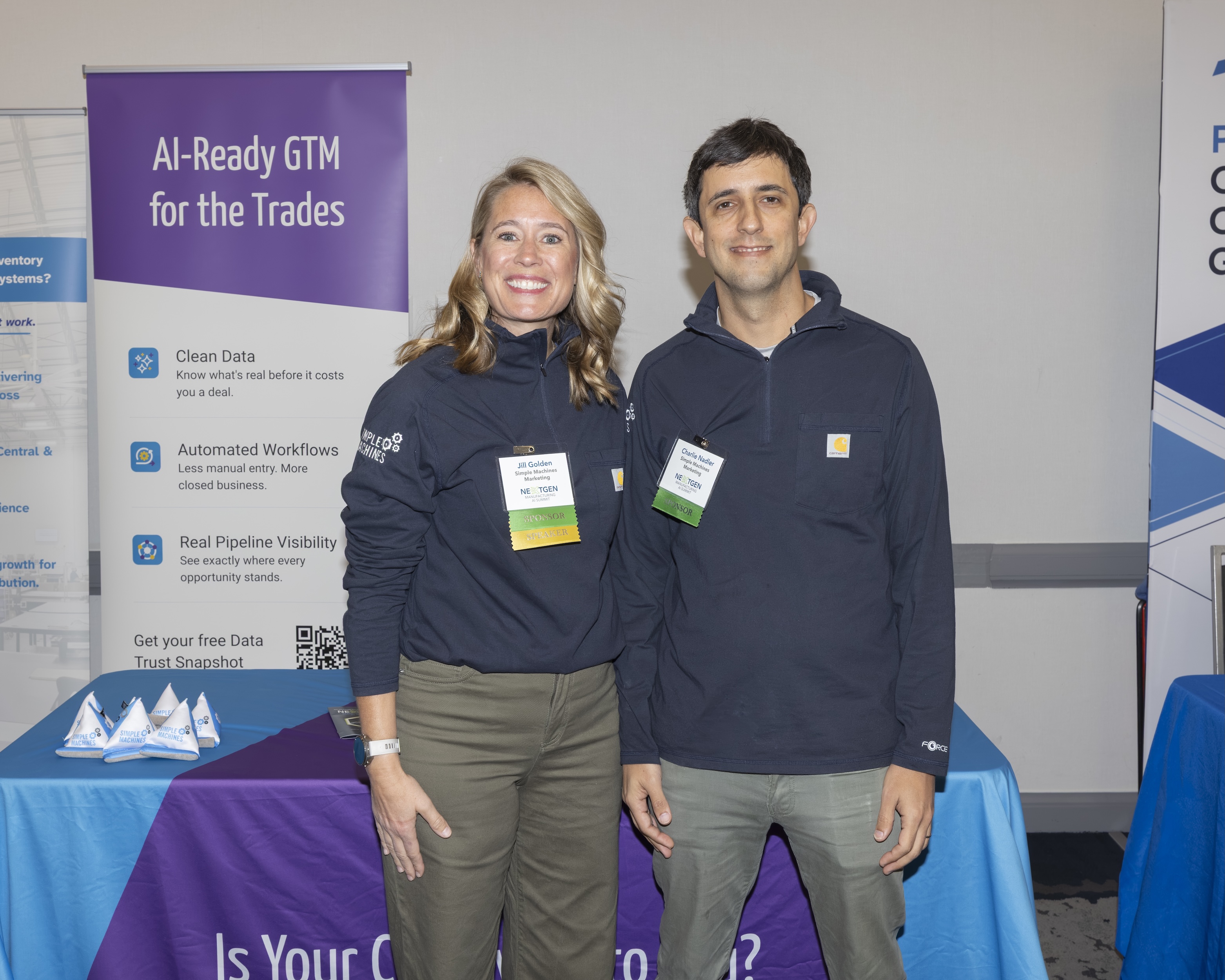
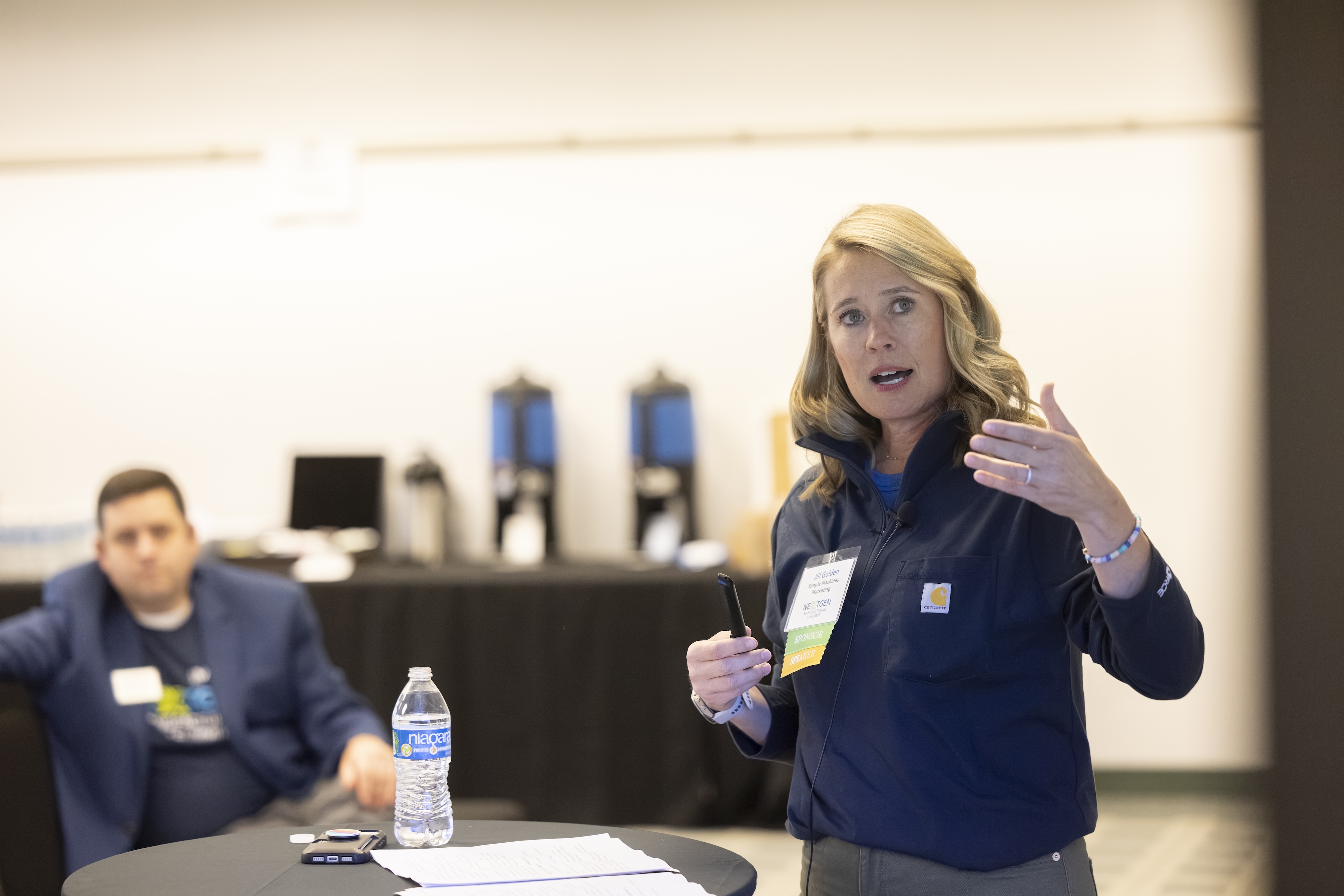
Last week, Simple Machines sponsored the 2026 NextGen Manufacturing AI Summit hosted by IMEC, in Downer’s Grove, Illinois. Our President, Jill Golden, gave a talk called "Will AI Shortlist You?" on how manufacturers get found when buyers research suppliers with AI. We also announced our new AI Acceleration in Manufacturing program. Here's what Jill covered.
The search box became an answer box
For 20 years, supplier research meant typing keywords, scanning ten links, and building a shortlist by hand. Now an engineer asks ChatGPT, Copilot,Gemini, Claude, or Perplexity a full question with five requirements in it, such as certification, location, material, tolerance, and volume. What comes back is a short list of names with a reason attached to each.
Jill's framing was that you're no longer competing to rank. You're competing to be included in the answer. There is no page two in an AI answer, and a buyer who never sees your name never visits your website. That research doesn't show up in your analytics.
Her caveat: traditional search is still huge, and many buyers still clickthrough to sources. This is a new front door, not a replacement for the old one.
Specialized beats big
The encouraging part for small and mid-sized manufacturers is that AI cares less about your ad budget than about whether you clearly answer the specific question. Ahrefsfound that 63% of 3,000 websites studied were already receiving AI-referred traffic, and smaller sites got a larger share of their traffic from AI than big brands did.
Jill shared an example from our own client work. A buyer asked AI for the best firms in a specialized field. It named the three industry giants and one small boutique firm, our client. That lead became a qualified opportunity. A 40-person job shop that documents a capability clearly can show up next to a billion-dollar competitor.
How an AI answer gets built, and where you can influence it
When a buyer asks a question, the AI doesn't search that exact sentence. It works out intent, then breaks the question into many smaller searches, a process called query fan-out. It reads the pages those searches return and writes a short list with reasons.
A question like "Best contract manufacturer in Illinois for medical device components?" fans out into searches on certifications, processes and materials, low-volume lead times, quality reputation, and alternatives to the big-name competitor. The companies that appear repeatedly across those fragments make the final list.
That changes the question from "Do we rank for this keyword?" to "Do we show up across the whole network of questions our buyers ask?" Jill's comparison: the old playbook was one keyword, one page. The new one is one question, many answers.
Why manufacturers get skipped
Jill named five common reasons, most of them fixable in-house:
- Specs locked in PDFs and images. Tolerances, materials, and capacities that AI can't easily read.
- Vague brochure language. "Precision solutions for demanding industries" could describe 10,000 companies and answers no buyer question.
- Gated or hidden content. AI can't fill out your form. Gate the deep dive if you must, but never the basic facts.
- Blocked or slow websites. Some platforms and firewalls block AI crawlers by default, sometimes without anyone choosing it.
- Inconsistent facts across the web. Your website, Thomasnet, distributor sites, and LinkedIn all say different things.
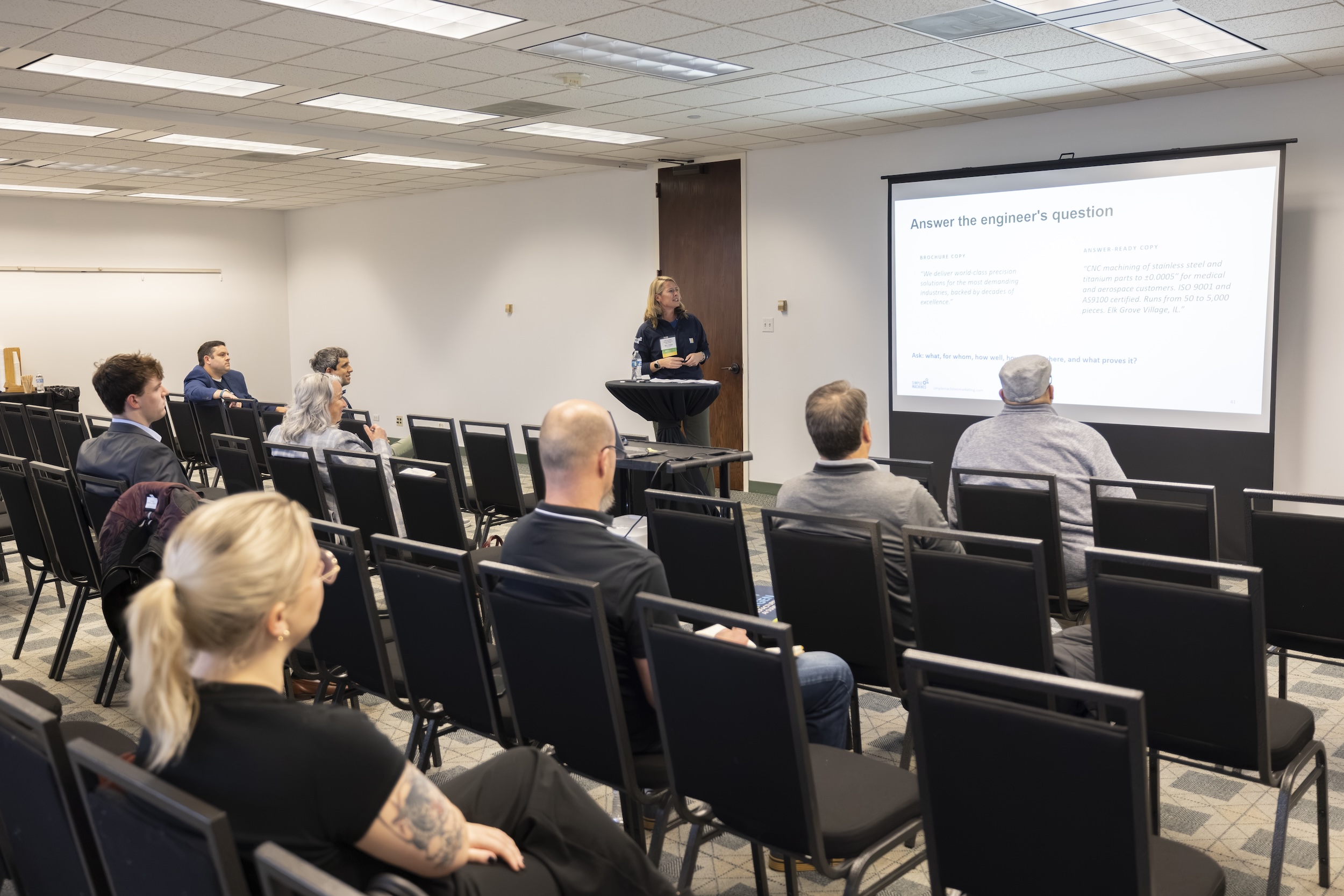
Her fix for the copy problem was a test: does each page say what you do, for whom, how well, how many, where, and what proves it? Compare"world-class precision solutions for the most demanding industries" with "CNC machining of stainless steel and titanium parts to ±0.0005″ for medical and aerospace customers, ISO 9001 and AS9100 certified, runs of 50 to 5,000 pieces." The second one gives AI something it can quote, and it helps a human engineer skimming your site too.
Becoming the sourceAI wants to cite
Beyond fixing the basics, Jill encouraged manufacturers to build the pages AI wants to quote:
- Deep capability pages, one per key process, material, or industry, with real specs.
- Honest comparison guides, such as electropolishing vs. passivation, that help buyers choose even when the answer isn't you.
- Fit pages that say who you're a great fit for and who you're not, which brings in better-fit inquiries.
Verifiable claims matter as much as content. AI cross-checks what you say against directories, distributors, registrars, and LinkedIn, so keep your name, address, and capabilities identical everywhere, cite certifications with the certifying body and date, and publish case studies with real numbers, like scrap rate or lead time.
Measure inclusion, not rankings
Jill's measurement approach is simple. Keep a fixed list of 20 to 40buyer questions across four buckets (discovery, comparison, reputation, and accuracy), run them in two or three AI tools on a regular schedule, and track how often answers name you and how they describe you. Answers vary day to day, so watch trends rather than single results. Check your analytics for AI referral traffic, and add "How did you hear about us?" to your forms. She noted the answer is often "ChatGPT."
A real example: Threekit. Threekit, an AI quoting platform for manufacturers, started with near-zero AI visibility in a new category. Jill disclosed that Threekit is a Simple Machines client, and that the case study was published by HubSpot.Working together, the team measured where they showed up on key buyer questions, found where competitors were named instead, and wrote content answering those exact questions. In six weeks, their AI visibility on key buyer questions rose from 17% to 25%, and the share of AI answers citing Threekit's own content rose from 48% to 65%. As Jill put it, 25% isn't winning the category. It's traction from a near-zero start, and a weekly rhythm of checking, writing, and tracking.
The 30-day starter plan
Jill closed with a plan most teams can run in-house:
- Week 1, Test: Write 20 real buyer questions, ideally sourced from your sales team. Run them in 2 to 3 AI tools and record who shows up.
- Week 2, Map gaps: Find where competitors are named and you're not, and what AI gets wrong about you.
- Week 3, Fix the basics: Rewrite your top five pages with clear facts. Check crawler access and site speed.
- Week 4, Align: Update your top listings to match your site, then rerun your questions to set your baseline.
Her expectation-setting: you won't see results in 30 days. AI tools update on their own schedules, so think in quarters, like SEO. SEO also remains the foundation. It's just no longer the finish line.
Announcing the AI Acceleration inManufacturing program
At the summit, we also announced our AI Acceleration in Manufacturing program. This program invites small manufacturers to apply to win a package including our AI readiness assessment, an AI acceleration roadmap, and one year of our website AI agent, Fulcrum, for free.
Learn more about the AI Acceleration in Manufacturing program →
Get the checklist
If you want a head start on the Week 3 work, download our free AI-Friendly Website Checklist.
And thank you to the summit organizers, our fellow sponsors and speakers, and everyone who stopped by to talk.